|
Legal & Tax Disclosure
ATTORNEY ADVERTISING.
This article is provided for general informational purposes only and does not constitute legal, financial, or tax advice. Reading this content does not create an attorney-client or professional advisory relationship. Laws vary by jurisdiction and are subject to change. You should consult a qualified professional regarding your specific circumstances. |
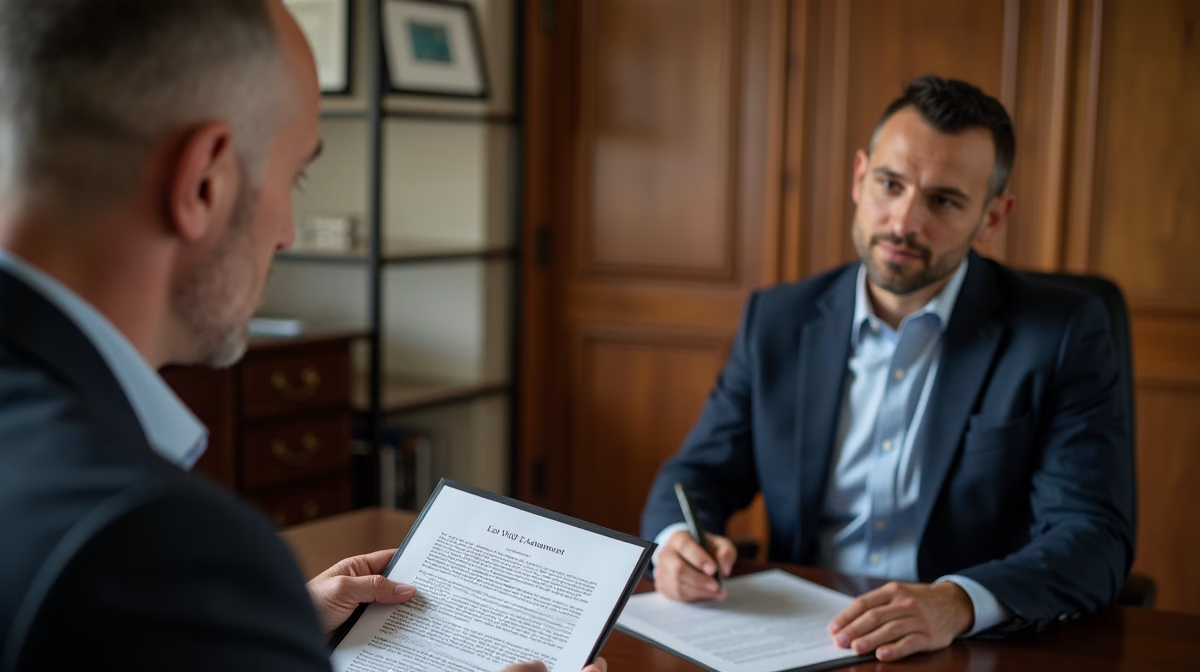
Darryl came to me absolutely devastated. His mother, Evelyn, had recently passed, and his sister, Denise, had drained Evelyn’s bank accounts in the months leading up to her death—accounts that were supposed to be used for Evelyn’s care. He’d reported it to the police, but they told him it was a complex financial crime, and they weren’t equipped to untangle it quickly. He was facing thousands in legal fees just to investigate, and the thought of a lengthy civil battle was overwhelming. He needed a way to recover the stolen assets and hold Denise accountable without losing everything in the process.
The short answer is: sometimes. Probate Court isn’t the first place you’d think of for elder abuse, but it’s often the most effective place to address it, particularly when the abuse involves financial exploitation. Many people assume they need to go straight to civil court, or even criminal court. However, the Probate Court offers unique tools that are ideally suited to unraveling these types of cases. As an Estate Planning Attorney and CPA with over 35 years of experience, I’ve seen firsthand how these tools can provide relief and restitution when traditional avenues fall short. My dual background is particularly helpful, because elder abuse often centers around the misappropriation of assets, requiring a deep understanding of both legal and financial principles – specifically, the step-up in basis, capital gains implications, and proper asset valuation.
How Does Probate Court Address Elder Abuse?

Probate Court can address elder abuse in a few key ways, primarily through what are called “spousal or heir petitions.” Even though Evelyn has already passed, Darryl has options. He can file a petition to challenge Denise’s actions as the executor of the estate. This isn’t a traditional lawsuit; instead, it’s an accounting proceeding where Denise is required to fully disclose all transactions related to Evelyn’s assets during her lifetime, and specifically, the time she was acting as executor. This forces transparency.
- Accounting: The executor must provide a detailed accounting of all funds received and disbursed. This immediately identifies any suspicious activity.
- Petition for Reimbursement: If funds were misappropriated, the court can order Denise to reimburse the estate—and ultimately, be distributed to Darryl.
- Removal of Executor: In egregious cases, the court can remove Denise as executor and appoint a neutral party.
Unlike civil court, which requires you to prove each element of a financial abuse claim, the Probate Court focuses on what actually happened to the estate’s assets. This is a lower evidentiary burden, making it easier to recover stolen funds. Plus, the court has the authority to order forensic accounting if the initial accounting is insufficient.
What If There’s a Criminal Investigation?
A criminal investigation and a Probate Court proceeding aren’t mutually exclusive. In fact, they can often work hand-in-hand. The police investigation focuses on whether a crime was committed, while the Probate Court focuses on restoring the estate. Often, the results of the Probate Court proceeding—like a forensic accounting report—can be used as evidence in the criminal case. It’s also important to note that the statute of limitations for criminal charges is often shorter than the time you have to file a petition in Probate Court.
What About Probate Notes and Tentative Rulings?
Before the judge ever sees your file, a ‘Probate Examiner’ reviews it for defects. They post ‘Probate Notes’ weeks in advance, outlining any issues with your petition. You MUST file a ‘Supplement’ to cure these defects before the hearing, or your case will be continued (delayed) for months. Additionally, most California probate departments post ‘Tentative Rulings’ online 1-2 days before the hearing. If the ruling is ‘Recommended for Approval’ and no one objects, the physical hearing may be waived. If you disagree with the ruling, you MUST notify the court and opposing counsel by 4:00 PM the day before.
What If the Assets Are Already Gone?
Even if Denise has already transferred the stolen funds to herself, the Probate Court may still be able to help. Under Probate Code § 850, the court has specialized jurisdiction to decide ownership disputes between the estate and third parties. This means the court can order Denise to return the funds, even if she’s already spent them, potentially through a lien on her assets. It’s also crucial to remember that fraudulent transfers can be “undone” by the court, effectively returning the assets to the estate. Finally, keep in mind that the court has the power to levy fines and sanctions against Denise, which can help offset your legal fees.
What causes California probate cases to spiral into delay, disputes, and extra cost?
California probate is designed to provide court-supervised transfer of property, yet cases often break down when authority is unclear, required steps are missed, or disputes arise over assets, notice, and fiduciary conduct. When the process is misunderstood, families can face avoidable delay, escalating conflict, and increased exposure to creditor issues, hearings, or litigation before the estate can close.
| Legal Foundation | Why It Matters |
|---|---|
| The Court | See the role of the probate court. |
| The Law | Review probate governing law. |
| Citations | Check legal authority in probate. |
A stable probate administration outcome usually follows from clarity, consistency, and readiness for court review, especially when multiple stakeholders and competing interpretations are involved. When documentation supports enforcement and timelines are respected, families are less likely to face preventable escalation.
Verified Authority on California Probate Court Operations
-
Jurisdiction & Venue: California Probate Code § 7051 (Domicile Rule)
This statute dictates strictly where the probate case must be heard. It is based on the decedent’s “domicile” (permanent legal residence), not where they died or where their property is located. Filing in the wrong county will result in the case being transferred or dismissed. -
The “850 Petition” (Title Disputes): California Probate Code § 850 (Heggstad/Title)
The Probate Court is not just for processing paperwork; it is a trial court that can determine property ownership. A Section 850 petition allows the judge to order property returned to the estate (from a thief) or transferred out of the estate (to a rightful owner) without a separate civil lawsuit. -
Oral Objections & Continuances: California Probate Code § 1043
You have a right to be heard. This code allows any interested person to appear at the hearing and object orally. The court may grant a continuance to allow you time to file a written objection. This is a critical tool for beneficiaries who find out about a hearing at the last minute. -
Appeals (What Orders are Final?): California Probate Code § 1300 (Appealable Orders)
Not every decision by a probate judge can be appealed immediately. This section lists exactly which orders are “appealable” (e.g., directing distribution, determining heirship). Understanding this list is vital for litigation strategy. -
Tentative Rulings: California Rules of Court 3.1308
In modern California probate practice, the “hearing” often happens on paper before the actual court date. This rule governs the Tentative Ruling system. Checking the tentative ruling the day before is mandatory practice; if you don’t contest it properly, the judge’s tentative decision becomes final. -
Fee Waivers: California Government Code § 68633
Probate filing fees are high (often $435+ per petition). This code authorizes the court to waive these fees for petitioners who are low-income or receiving public benefits, ensuring that access to the probate court is not limited only to the wealthy.
|
Attorney Advertising, Legal Disclosure & Authorship
ATTORNEY ADVERTISING.
This content is provided for general informational and educational purposes only and does not constitute legal, financial, or tax advice. Under the California Rules of Professional Conduct and State Bar advertising regulations, this material may be considered attorney advertising. Reading this content does not create an attorney-client relationship or any professional advisory relationship. Laws vary by jurisdiction and are subject to change, including recent 2026 developments under California’s AB 2016 and evolving federal estate and reporting requirements. You should consult a qualified attorney or advisor regarding your specific circumstances before taking action.
Responsible Attorney:
Steven F. Bliss, California Attorney (Bar No. 147856).
Local Office:
Moreno Valley Probate Law23328 Olive Wood Plaza Dr suite h Moreno Valley, CA 92553 (951) 363-4949
Moreno Valley Probate Law is a practice location and trade name used by Steven F. Bliss, Esq., a California-licensed attorney.
About the Author & Legal Review Process
This article was researched and drafted by the Legal Editorial Team of the Law Firm of Steven F. Bliss, Esq.,
a collective of attorneys, legal writers, and paralegals dedicated to translating complex legal concepts into clear, accurate guidance.
Legal Review:
This content was reviewed and approved by Steven F. Bliss, a California-licensed attorney (Bar No. 147856). Mr. Bliss concentrates his practice in estate planning and estate administration, advising clients on proactive planning strategies and representing fiduciaries in probate and trust administration proceedings when formal court involvement becomes necessary.
With more than 35 years of experience in California estate planning and estate administration,
Mr. Bliss focuses on structuring enforceable estate plans, guiding fiduciaries through court-supervised proceedings, resolving creditor and notice issues, and coordinating asset management to support compliant, timely distributions and reduce fiduciary risk. |