|
Legal & Tax Disclosure
ATTORNEY ADVERTISING.
This article is provided for general informational purposes only and does not constitute legal, financial, or tax advice. Reading this content does not create an attorney-client or professional advisory relationship. Laws vary by jurisdiction and are subject to change. You should consult a qualified professional regarding your specific circumstances. |
Darryl thought he had everything perfect. His mother’s estate was straightforward: a small home, a checking account, and a valid will leaving everything to him. He filed the Petition for Probate, feeling confident. Then came the “Probate Notes.” A terse, one-page document from the court, listing a dozen “defects” in his filing. Darryl was panicked – what defects? He hadn’t missed a single form, hadn’t forgotten a single signature. The cost of his stress and wasted time quickly exceeded $5,000 as he scrambled to understand the court’s demands.
As an Estate Planning Attorney and CPA with over 35 years of experience, I see this happen constantly. People try to navigate Probate alone, believing it’s “just paperwork.” But Probate isn’t about filling in blanks; it’s about satisfying a complex set of legal requirements, and a meticulous Probate Examiner will find any deviation. That’s where the “Probate Notes” come in.
What are Probate Notes?
Before the judge ever sees your file, a “Probate Examiner” reviews it for defects. These Examiners are not attorneys, but they are highly trained court personnel familiar with the Probate Code. They post “Probate Notes” weeks in advance of your hearing, detailing every error, omission, or technical deficiency in your petition. The notes are often cryptic, written in legal shorthand, and can be incredibly frustrating to decipher.
Why are Probate Notes so important?
Ignoring the Probate Notes is a fatal mistake. The court will not grant your petition until all defects are cured. Attempting to proceed without addressing them will almost certainly result in a continuance – a delay of months while you fix the issues and resubmit your filing. More importantly, a delayed Probate means delayed access to assets, continuing legal expenses, and increased stress for you and your family.
From a CPA’s perspective, the delay is particularly harmful. The value of the assets as of the date of death is critical for establishing the “step-up in basis.” The longer the Probate takes, the more likely the asset values will change, potentially increasing capital gains taxes later on. Correcting the Probate Notes efficiently preserves this accurate valuation and minimizes your tax liability.
How do I address Probate Notes?
You MUST file a “Supplement” to your petition, specifically addressing each note. The Supplement should clearly identify the note number, explain the correction you’ve made, and attach any supporting documentation. The court expects a point-by-point response, demonstrating that you’ve thoroughly addressed each concern.
The key is understanding why the Examiner flagged the issue. Sometimes it’s a simple clerical error, like an incorrect date. Other times, it’s a more substantive legal problem requiring careful analysis and potentially amendment of the petition itself. If you’re unsure how to respond, that’s where experienced legal counsel is invaluable.
Furthermore, don’t rely on assumptions. What seems obvious to you may not be clear to the Examiner. Be thorough, precise, and anticipate potential follow-up questions.
What if I disagree with a Probate Note?
Occasionally, an Examiner will make an error, or their interpretation of the law will be incorrect. In these cases, you can contest the note. However, doing so requires careful legal research and a persuasive argument. Simply stating your disagreement is not enough; you must present legal authority to support your position.
- Understand the Basis of the Note: Before contesting, ensure you fully understand why the note was issued.
- Legal Research: Cite relevant Probate Code sections or case law supporting your argument.
- Written Response: File a formal response to the court, clearly outlining your disagreement and supporting legal authority.
The Benefit of a CPA-Attorney
As a CPA as well as an Estate Planning Attorney, I’m uniquely qualified to handle Probate Notes. I understand the tax implications of every decision, ensuring that the Probate is not only legally sound but also minimizes your tax burden. My 35+ years of experience allows me to anticipate potential issues, efficiently address Probate Notes, and protect your family’s financial future.
What failures trigger contested proceedings and court intervention in California probate administration?
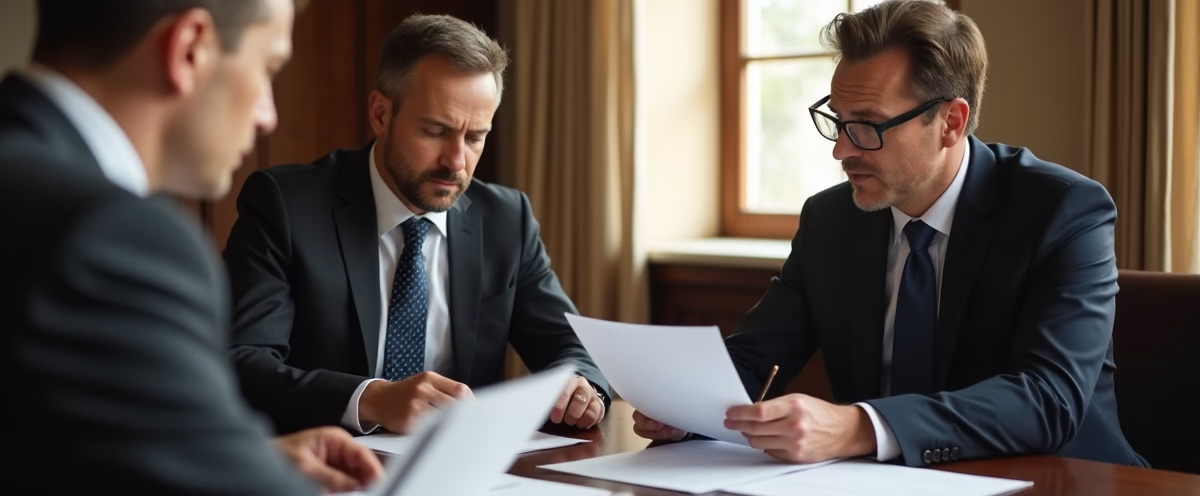
Success in probate court depends less on the size of the estate and more on the accuracy of the petition and the behavior of the fiduciary. Whether the issue is a forgotten asset, a contested creditor claim, or a disagreement among siblings, understanding the procedural triggers for court intervention is the best defense against prolonged administration.
| End Game | Consideration |
|---|---|
| Wrap Up | Execute final distribution and closing. |
| IRS/FTB | Address probate tax implications. |
| Results | Review remedies and outcomes. |
California probate is most manageable when authority is documented early, assets are classified correctly, and procedure is followed consistently from petition through closing. When the process is approached with realistic expectations about notice, claims, accounting, and dispute risk, the estate is more likely to move toward closure without avoidable conflict or delay.
Verified Authority on California Probate Court Operations
-
Jurisdiction & Venue: California Probate Code § 7051 (Domicile Rule)
This statute dictates strictly where the probate case must be heard. It is based on the decedent’s “domicile” (permanent legal residence), not where they died or where their property is located. Filing in the wrong county will result in the case being transferred or dismissed. -
The “850 Petition” (Title Disputes): California Probate Code § 850 (Heggstad/Title)
The Probate Court is not just for processing paperwork; it is a trial court that can determine property ownership. A Section 850 petition allows the judge to order property returned to the estate (from a thief) or transferred out of the estate (to a rightful owner) without a separate civil lawsuit. -
Oral Objections & Continuances: California Probate Code § 1043
You have a right to be heard. This code allows any interested person to appear at the hearing and object orally. The court may grant a continuance to allow you time to file a written objection. This is a critical tool for beneficiaries who find out about a hearing at the last minute. -
Appeals (What Orders are Final?): California Probate Code § 1300 (Appealable Orders)
Not every decision by a probate judge can be appealed immediately. This section lists exactly which orders are “appealable” (e.g., directing distribution, determining heirship). Understanding this list is vital for litigation strategy. -
Tentative Rulings: California Rules of Court 3.1308
In modern California probate practice, the “hearing” often happens on paper before the actual court date. This rule governs the Tentative Ruling system. Checking the tentative ruling the day before is mandatory practice; if you don’t contest it properly, the judge’s tentative decision becomes final. -
Fee Waivers: California Government Code § 68633
Probate filing fees are high (often $435+ per petition). This code authorizes the court to waive these fees for petitioners who are low-income or receiving public benefits, ensuring that access to the probate court is not limited only to the wealthy.
|
Attorney Advertising, Legal Disclosure & Authorship
ATTORNEY ADVERTISING.
This content is provided for general informational and educational purposes only and does not constitute legal, financial, or tax advice. Under the California Rules of Professional Conduct and State Bar advertising regulations, this material may be considered attorney advertising. Reading this content does not create an attorney-client relationship or any professional advisory relationship. Laws vary by jurisdiction and are subject to change, including recent 2026 developments under California’s AB 2016 and evolving federal estate and reporting requirements. You should consult a qualified attorney or advisor regarding your specific circumstances before taking action.
Responsible Attorney:
Steven F. Bliss, California Attorney (Bar No. 147856).
Local Office:
Moreno Valley Probate Law23328 Olive Wood Plaza Dr suite h Moreno Valley, CA 92553 (951) 363-4949
Moreno Valley Probate Law is a practice location and trade name used by Steven F. Bliss, Esq., a California-licensed attorney.
About the Author & Legal Review Process
This article was researched and drafted by the Legal Editorial Team of the Law Firm of Steven F. Bliss, Esq.,
a collective of attorneys, legal writers, and paralegals dedicated to translating complex legal concepts into clear, accurate guidance.
Legal Review:
This content was reviewed and approved by Steven F. Bliss, a California-licensed attorney (Bar No. 147856). Mr. Bliss concentrates his practice in estate planning and estate administration, advising clients on proactive planning strategies and representing fiduciaries in probate and trust administration proceedings when formal court involvement becomes necessary.
With more than 35 years of experience in California estate planning and estate administration,
Mr. Bliss focuses on structuring enforceable estate plans, guiding fiduciaries through court-supervised proceedings, resolving creditor and notice issues, and coordinating asset management to support compliant, timely distributions and reduce fiduciary risk. |