This article is provided for general informational purposes only and does not constitute legal, financial, or tax advice.
Reading this content does not create an attorney-client or professional advisory relationship.
Laws vary by jurisdiction and are subject to change. You should consult a qualified professional regarding your specific circumstances.
Emily lost the codicil. Not misplaced – lost. She’d meticulously drafted it, updating her estate plan after her mother’s passing, and placed it in a safety deposit box. A recent bank audit revealed the box hadn’t been accessed in years, and the codicil was simply…gone. Now, her brother Mac is challenging the original will, claiming Emily’s intentions were clear she wanted him to receive the antique coin collection. The cost? Potentially tens of thousands in legal fees and a fractured family relationship, all because of a missing signature.
As an Estate Planning Attorney and CPA with over 35 years of experience here in Moreno Valley, I see this happen far too often. Clients believe the probate process is a formality, a simple rubber stamp. They underestimate the importance of meticulously following procedure, and the potential consequences of a lost document or missed deadline. My unique background as both an attorney and a CPA allows me to navigate these complex issues with a level of insight most estate lawyers simply can’t match. Understanding the tax implications – the step-up in basis, potential capital gains, and accurate valuation of assets – is absolutely critical to protecting your family’s inheritance.
What Happens If I Don’t Show Up to the Probate Hearing?
This is a frequent question, and the answer is critically important. Probate Code § 1220 dictates that if you miss a hearing because you weren’t properly notified, the resulting order could be void. The person initiating the probate – the “petitioner” – has a strict duty to mail the Notice of Hearing (Form DE-120) to all interested parties at least 15 days beforehand. A missing “Proof of Service” in the court file is an automatic stop to the hearing. However, simply claiming you didn’t receive notice isn’t enough. You must prove it.
More often, though, the issue isn’t lack of notice, but simply forgetting the date or underestimating the importance of attending. While California law now permanently allows for remote appearances in probate hearings, provided you give notice, it’s not a guarantee. Code of Civil Procedure § 367.75 outlines this provision, but remember the judge retains discretion to require personal appearances, particularly for evidentiary hearings or trials.
What Evidence is Needed at the Hearing?
Many clients mistakenly believe they can simply tell the judge their side of the story. That’s rarely effective. Probate Code § 1022 clarifies that standard probate hearings aren’t typically “live witness” events. Instead, an affidavit or verified petition serves as the primary evidence. If you intend to present live testimony, the judge will almost certainly continue the matter to a separate “Evidentiary Hearing” or trial date, adding significant delay and expense.
Think of the hearing as a preliminary review of the paperwork. The judge is looking to see if the documents are complete, legally sufficient, and if there are any credible objections. Submitting a clear, well-organized petition with supporting documentation is your first line of defense.
How Do I Object to Something at the Hearing?
You don’t need to file a lengthy, expensive legal brief to voice your concerns. Probate Code § 1043 allows you to appear and object orally at the first hearing. However, doing so will trigger a continuance – usually 30 days – allowing the other party time to respond with written objections. While this buys you time to prepare a formal response, it also extends the probate process and increases legal costs. Effective oral objection requires clearly stating the basis for your challenge.
What About the Actual Court Order? Who Writes That?
This is a surprisingly common issue. California Rule of Court 3.1312 places the responsibility of preparing the “Proposed Order” on the prevailing party. The judge doesn’t typically draft it for you. If the judge grants your petition but there’s no Proposed Order in the file, you leave with nothing. It’s your responsibility to ensure the order accurately reflects the judge’s ruling and is submitted to the court before the hearing.
What if There are Issues with the Probate Notes?
The Probate Court’s “Notes” section on each case can be a major source of delay. Most hearing delays are caused by uncleared “Probate Notes.” You can’t simply explain the issue to the judge in court; you must file a verified “Supplement to Petition” in writing at least 2-3 court days before the hearing to satisfy the Probate Examiner. These notes often relate to minor issues with documentation, but if not addressed, they can grind the process to a halt.
How do enforcement rules in California probate court shape outcomes for heirs and fiduciaries?
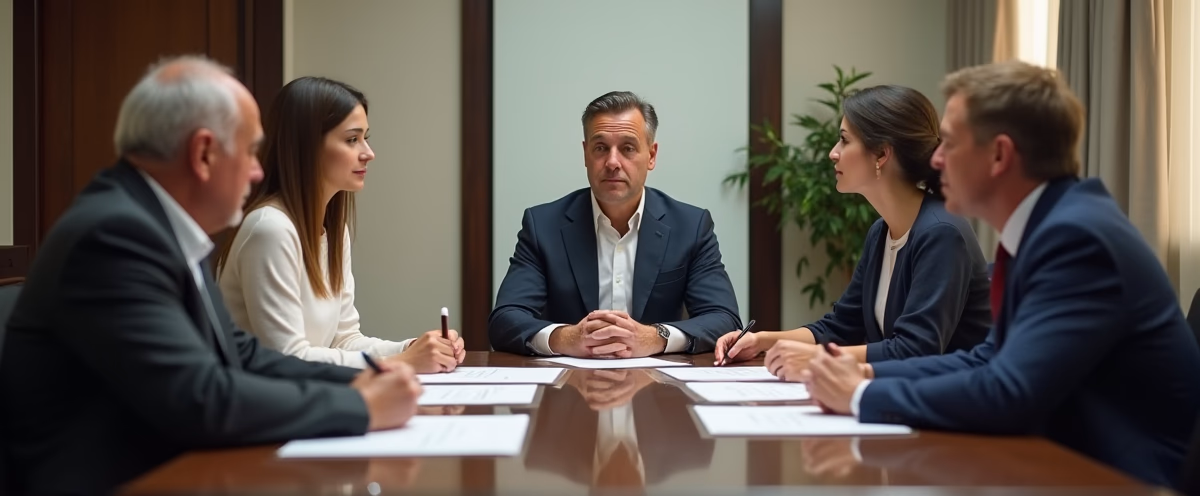
The path through California probate is rarely a straight line; it requires precise adherence to statutory deadlines, accurate asset characterization, and strict fiduciary compliance. Without a clear roadmap, what begins as a standard administrative proceeding can quickly dissolve into a costly battle over interpretation, valuation, and beneficiary rights.
| Legal Foundation | Why It Matters |
|---|---|
| The Court | See the role of the probate court. |
| The Law | Review probate legal rules. |
| Legal Basis | Check governing legal authorities. |
California probate is most manageable when authority is documented early, assets are classified correctly, and procedure is followed consistently from petition through closing. When the process is approached with realistic expectations about notice, claims, accounting, and dispute risk, the estate is more likely to move toward closure without avoidable conflict or delay.
Verified Authority on California Probate Hearings
-
Oral Objections (The “Stop” Button): California Probate Code § 1043
This is the most important statute for beneficiaries. It grants an interested person the right to appear at the hearing and object orally to the petition. Once an oral objection is made, the court generally must continue the hearing to allow time for written objections to be filed. -
Remote Appearances (Zoom/CourtCall): California Code of Civil Procedure § 367.75
Modern probate hearings are often hybrid. This code section governs the right to appear remotely. While convenient, note that the court can typically require a physical appearance for “evidentiary” hearings where witness credibility is being judged. -
Affidavits as Evidence: California Probate Code § 1022
Unlike criminal court, probate hearings rely heavily on paper. A verified petition or an affidavit is admissible as evidence in an uncontested probate hearing. This is why “clearing your notes” in writing is more important than your oral argument. -
Notice of Hearing Requirements: California Probate Code § 1220
The court’s jurisdiction depends on this. The petitioner must mail notice of the hearing at least 15 days in advance to all interested parties. If the “Proof of Service” is not filed or is defective, the judge cannot legally hold the hearing. -
Lodging the Proposed Order: California Rules of Court 3.1312
A common rookie mistake is showing up without the paperwork. The “Proposed Order” (the document the judge signs) should generally be lodged with the court before the hearing. If the judge approves your petition but has nothing to sign, your Letters cannot be issued. -
Proving the Will (Witnesses): California Probate Code § 8220
If a Will is contested, or if it is not “self-proving” (lacking a proper attestation clause), the court may require the testimony of a subscribing witness at the hearing to prove the Will is authentic.
|
Attorney Advertising, Legal Disclosure & Authorship
ATTORNEY ADVERTISING.
This content is provided for general informational and educational purposes only and does not constitute legal, financial, or tax advice. Under the California Rules of Professional Conduct and State Bar advertising regulations, this material may be considered attorney advertising. Reading this content does not create an attorney-client relationship or any professional advisory relationship. Laws vary by jurisdiction and are subject to change, including recent 2026 developments under California’s AB 2016 and evolving federal estate and reporting requirements. You should consult a qualified attorney or advisor regarding your specific circumstances before taking action.
Responsible Attorney:
Steven F. Bliss, California Attorney (Bar No. 147856).
Local Office:
Moreno Valley Probate Law23328 Olive Wood Plaza Dr suite h Moreno Valley, CA 92553 (951) 363-4949
Moreno Valley Probate Law is a practice location and trade name used by Steven F. Bliss, Esq., a California-licensed attorney.
About the Author & Legal Review Process
This article was researched and drafted by the Legal Editorial Team of the Law Firm of Steven F. Bliss, Esq.,
a collective of attorneys, legal writers, and paralegals dedicated to translating complex legal concepts into clear, accurate guidance.
Legal Review:
This content was reviewed and approved by Steven F. Bliss, a California-licensed attorney (Bar No. 147856). Mr. Bliss concentrates his practice in estate planning and estate administration, advising clients on proactive planning strategies and representing fiduciaries in probate and trust administration proceedings when formal court involvement becomes necessary.
With more than 35 years of experience in California estate planning and estate administration,
Mr. Bliss focuses on structuring enforceable estate plans, guiding fiduciaries through court-supervised proceedings, resolving creditor and notice issues, and coordinating asset management to support compliant, timely distributions and reduce fiduciary risk. |