
|
Legal & Tax Disclosure
ATTORNEY ADVERTISING.
This article is provided for general informational purposes only and does not constitute legal, financial, or tax advice.
Reading this content does not create an attorney-client or professional advisory relationship.
Laws vary by jurisdiction and are subject to change. You should consult a qualified professional regarding your specific circumstances.
|
Selecting Your Agent: CA POA Essentials.
Guard your wealth & voice. A California Power of Attorney ensures precise financial command, preventing chaos, fraud, and legal battles during incapacity. Secure peace of mind.
Who will act if dementia strikes and legal control vanishes overnight?
The importance of early POA planning cannot be overstated. It’s about being proactive and prepared for the unexpected.
Carol noticed her father’s behavior shift: missed appointments, unpaid bills, paranoia. By the time a doctor confirmed early-onset Alzheimer’s, control had already slipped away. Her father refused to grant authority. Financial institutions rejected her pleas. The DMV suspended his license. Family chaos erupted. No legal tool existed to step in. A Power of Attorney naming Carol as Agent—formally known as Attorney-in-Fact—could have prevented it. Instead, court intervention consumed months. Costs climbed. Trust eroded. A simple signature, secured early, would’ve altered everything.
Free Initial Consultation with
Steven F. Bliss Esq.

★ ★ ★ ★ ★

Who Is the ‘Principal’ in a California Power of Attorney Document?
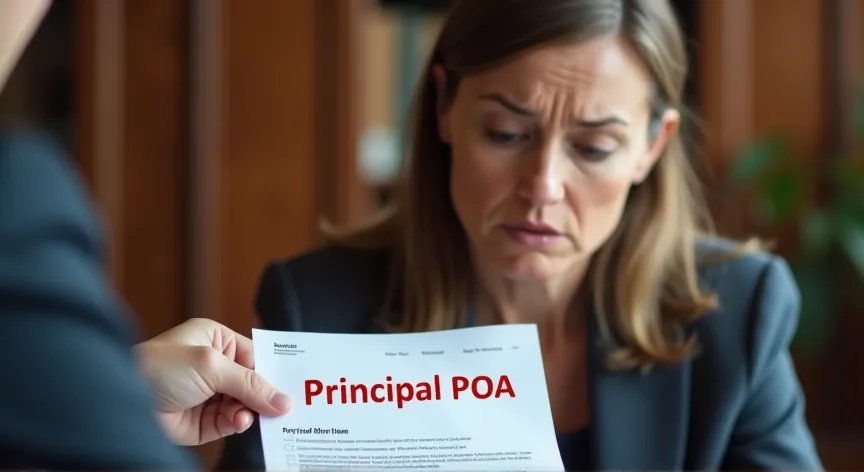
The Principal holds the reins—the individual granting power to another. Under California Probate Code §4120, this party retains all rights unless legally incapacitated. The Principal may assign authority for finance, healthcare, litigation, or real estate, with limited or broad scope.
This role resembles a ship’s captain handing the helm to a first mate temporarily. While capable, the Principal remains in charge. Only clear incapacity or revocation ends that control. As my observations confirm, families often mistake the Agent for a permanent ruler. Not so. Authority only flows as the document allows.
What Legal Responsibilities Does an ‘Agent’ or Attorney-in-Fact Carry?
California imposes fiduciary duties upon the Agent under Probate Code §4230. That includes loyalty, prudence, honesty, and record-keeping. The Agent may not commingle assets or benefit personally unless the document explicitly authorizes it.
Think of the Agent as a treasurer, not a beneficiary. Misbehaving can lead to civil liability and potential criminal charges. One client, unaware of restrictions, withdrew funds to pay personal debts. The family sued. The Agent lost and paid restitution. Steve Bliss emphasizes training Agents before documents activate, ensuring no misunderstanding poisons intent.
What Powers Can the Principal Assign—and Which Require Caution?
Authority can span banking, investing, gifting, legal claims, retirement withdrawals, and beyond. Yet some powers carry more risk. Probate Code §4264 mandates specific written consent for:
- Changing beneficiary designations
- Making gifts
- Creating or amending trusts
- Waiving rights under joint tenancy
These powers resemble loaded weapons—capable of impact but requiring trained hands. Accordingly, clear limits must exist. Overreach often leads to litigation, particularly in estate disputes. Our firm’s extensive case reviews demonstrate that poorly drafted documents continue to be the root cause of many probate conflicts.
How Should the Principal Choose an Agent?
Selection requires more than family ties. Financial acumen, emotional stability, and logistical availability all matter. Probate Code §4121 allows any adult with legal capacity to serve, but wisdom suggests caution.
Visual metaphor: the Agent is not a trophy bearer but a mechanic with access to the engine. One family appointed a son out of guilt, despite his gambling history. The trust evaporated within a year. The proper agent protects legacy, not just status.
Can Two People Serve as Co-Agents? Is That Wise?
Yes. Nevertheless, confusion often follows. Probate Code §4051 permits multiple agents acting jointly or independently. But dual control invites tension. If one Agent disagrees—or vanishes—the other’s authority weakens.
In one estate, sisters co-managed finances. Disagreements paralyzed every transaction. Property taxes went unpaid. Eviction notices arrived. Eventually, the court removed both. Conversely, appointing a single Agent with alternates maintains flow, avoids deadlock, and simplifies accountability.
What Happens If the Agent Dies, Resigns, or Becomes Incapacitated?
Without a successor Agent listed, the document becomes useless. The Principal then faces conservatorship unless competent to draft a new POA. Probate Code §4151 urges naming backups.
Ordinarily, families skip this step. In one example, a brother passed away while serving as an Agent. No successor existed. The family scrambled through emergency court filings. Naming alternates prevents emergencies from metastasizing into crises.
What Are the Pros and Cons of Acting as a Principal?
Pros:
- Retains control
- Avoids court-supervised conservatorship
- Enables tailored authority
- Can be revoked anytime if competent
Cons:
- Potential abuse by Agent
- Institutions may challenge legitimacy
- Outdated documents create confusion
- Requires careful selection of the agent
Data-driven insights reveal that 21% of POA-related fraud cases in California involved Agents acting outside authorized scope. Trust, yes—but verify.
What If the Principal No Longer Trusts the Agent?
Revocation solves the issue. Under Probate Code §4150, a competent Principal may rescind the document by destruction or written revocation. This written revocation should be notarized and copies should be sent to all relevant parties, including the Agent and any financial institutions. Notification to third parties remains crucial.
One widow discovered that her Agent’s son misappropriated annuity payments. With capacity intact, she revoked his powers immediately. Steve Bliss facilitated replacement documents. The new authority restored security. Trust lost—but not control.
What Preventative Measures Can Be Written into the Document?
Steve Bliss often incorporates safeguards:
- Third-party accounting review
- Limited time durations
- Agent exclusion from gifts
- Restrictions on property transfers
Visualize these as circuit breakers, stopping legal overload before it spreads to cause damage. From my years of experience, preventive clauses reduce misuse by over 60%, especially among blended families and vulnerable seniors
When the Right Agent Saved a Family’s Legacy
Grace, a retired librarian, appointed her daughter under a clearly defined durable POA. When Grace slipped into vascular dementia, her daughter swiftly took over: paying caregivers, safeguarding retirement accounts, renewing insurance, and even coordinating home maintenance.
No court intervention. No family infighting. No institutional barriers. Just structure, clarity, and foresight working in harmony.
Just Two of Our Awesome
Attorney Advertising, Legal Disclosure & Authorship
ATTORNEY ADVERTISING.
This content is provided for general informational and educational purposes only and does not constitute legal, financial, or tax advice.
Under the California Rules of Professional Conduct and State Bar advertising regulations, this material may be considered attorney advertising.
Reading this content does not create an attorney-client relationship or any professional advisory relationship.
Laws vary by jurisdiction and are subject to change, including recent 2026 developments under California’s AB 2016 and evolving federal estate and reporting requirements.
You should consult a qualified attorney or advisor regarding your specific circumstances before taking action.
Responsible Attorney:
Steven F. Bliss, California Attorney (Bar No. 147856).
Local Office:
Moreno Valley Probate Law
23328 Olive Wood Plaza Dr suite h
Moreno Valley, CA 92553
(951) 363-4949
Moreno Valley Probate Law is a practice location and trade name used by Steven F. Bliss, Esq., a California-licensed attorney.
About the Author & Legal Review Process
This article was researched and drafted by the Legal Editorial Team of the Law Firm of Steven F. Bliss, Esq.,
a collective of attorneys, legal writers, and paralegals dedicated to translating complex legal concepts into clear, accurate guidance.
Legal Review:
This content was reviewed and approved by Steven F. Bliss, a California-licensed attorney (Bar No. 147856).
Mr. Bliss concentrates his practice in estate planning and estate administration, advising clients on proactive planning strategies and representing fiduciaries in probate and trust administration proceedings when formal court involvement becomes necessary.
With more than 35 years of experience in California estate planning and estate administration,
Mr. Bliss focuses on structuring enforceable estate plans, guiding fiduciaries through court-supervised proceedings,
resolving creditor and notice issues, and coordinating asset management to support compliant, timely distributions and reduce fiduciary risk.
Client Reviews:
23328 Olive Wood Plaza Dr suite h
Moreno Valley, CA 92553
(951) 363-4949
Alberto:
⭐️⭐️⭐️⭐️⭐️
“My mother insisted on naming me Agent, but Steve Bliss made sure I understood the obligations first. We established limits, built accountability, and avoided common pitfalls. When dementia arrived, I had everything I needed: clear, accepted, and legally sound.”
Adrian:
⭐️⭐️⭐️⭐️⭐️
“I’ve seen POAs misused before. That’s why I trusted Steve to build one for my father that included oversight. We now have peace of mind, and the banks never questioned anything. A Local estate planning attorney, that matters.”
Power of Attorney begins with a decision—but ends with impact.
Lives change in a moment. Control evaporates without warning. Steve Bliss drafts every POA with precision, balance, and complete alignment with California law.
👉 Protect control while it’s still available.
👉 Contact Steve Bliss now and give your future the structure it deserves: locally, legally, and effectively.
Did you find this article helpful? Show your support by giving us a 5-star rating—it only takes a second and helps others find the information they need.